
[Bank of the West/BNP Paribas]
Prices and consumption are on the rise. But so are non-dairy alternatives. How is the industry coping?
The dairy industry, long fighting depressed milk prices and changing consumer tastes, is confronting another uncertain year ahead.
On the surface, the future looks bright. Overall dairy consumption in the U.S. continues to increase, farmers have enjoyed a recent strengthening in domestic prices, and recent U.S. dairy exports have been on the rise.
“The dairy sector is finally showing some rebound after several years of losing money and consolidation,” said Robert Fox, Director and Senior Relationship Manager in the food and agribusiness group of Bank of the West. “Things aren’t great by any stretch, and it’s been a long haul for several years, but finally, things are starting to look better.”
Still, an ongoing consumer shift away from fluid milk to other dairy products and protein-rich, non-dairy alternatives keeps the industry wary of the future And it remains to be seen whether the industry can overcome the challenges that linger from its recent, lean years.
The Lesson of Dean Foods
The most public example of pressures within the industry came in November with the bankruptcy filing of Dean Foods Co., the largest U.S. milk company, which produces the leading white milk and flavored milk brands, DairyPure and TruMoo. After a spree of corporate mergers, the company was saddled with nearly $1 billion in debt at the same time the demand for fluid milk was declining.
Although demand for all dairy products per capita has increased in the U.S. at about 0.5 percent per year over the past two decades, consumer tastes for fluid milk and ice cream have fallen significantly during the period.
Profit margins for fluid milk processors have also been squeezed by a surge of private label milk as giant retailers stepped in to capture a slice of the popular food staple. Walmart announced in 2016 that it would build a dairy processing plant in Indiana to supply about 600 of its stores with private-label milk. The Kroger and Albertsons grocery store chains followed suit within the next year, while Amazon in early 2019 expanded the offerings of its private label Happy Belly to include milk sold through Amazon Fresh.
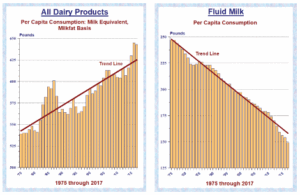
Source: Federal Milk Market Administrator
Welcome Prices
Ironically, Dean Foods was also hurt partly because of rapidly improving producer prices for fluid milk, which cut into the company’s profit margin but was a welcome development among farmers.
After years of pressure from a global oversupply, this rise in price has been sorely needed as farmers in general continue to lose money. In fact, the milk price for farmers in the U.S. last year was roughly the same as it was more than 40 years ago and remains stubbornly below the cost of production everywhere in the U.S., except California.
Even with the passage of the 2018 farm bill, which provided some relief, the number of dairy farms is expected to shrink. With more than 600,000 dairy farms in 1970, fewer than 38,000 existed by 2018.
Some relief arrived over the past year, though, as the wholesale price of milk jumped more than 30 percent, having averaged $14.84 per hundredweight during 2018 and hitting $19.33 per hundredweight by the end of 2019. (A hundredweight of milk, the standard industry measurement, equals 100 pounds, or about 11.6 gallons—a little less than a cow produces every two days.)
Whether those higher prices can be maintained, however, remains to be seen.
After years of steady consumer prices, “consumer inflation in the dairy segment has reappeared,” observed Fox, whose group’s loan portfolio to the industry exceeded $7 billion with nearly 900 clients as of year-end 2018. “So, that’ll bring another pressure point to the consumer and could really level off demand.” Fox said that expectations are for milk production prices to remain higher next year, but not at current levels.
Changing Tastes
Another factor pressuring the industry is a consumer shift to more plant-based, protein-rich drinks, and an array of substitute butters.
While consumption of dairy butter and cheese continues to grow, these other products could have a significant impact. Among the newest trends within the dairy market, Fox said, was an expanded range of flavored milks, more exotic yogurts, including new ingredients such as aloe, a mix of plant-based drinks added to dairy milk, and ultra-filtered milk with higher protein and lower natural sugars.
In terms of dairy substitutes, Whole Foods Market said in this year’s annual forecast of food trends that it expected in 2020 to witness an increased use of grains and mung beans, in addition to soy, to “mimic the creamy textures of yogurts and other dairy products.” The grocery store chain also predicted that new butters, made from a growing list of nuts and seeds, including watermelon seeds, cashews, and almonds, will be increasingly popular substitutes for the traditional dairy product.
That consumer shift has been occurring for several years. A survey by Mintel found that in just the five years through 2017, non-dairy milk sales in the U.S. had jumped 61 percent, with pecan and quinoa milk joining almond, soy, and coconut as popular alternatives.
A separate survey at the end of 2018 reported that while nearly all adults had purchased dairy milk in the previous year (92 percent), more than half also bought plant-based milk (52 percent), with almond milk the most popular product in that category.
And even as yogurt consumption has more than doubled since 2000, with an average 13.4 pounds consumed per person in 2018, the industry is increasingly concerned about a recent slump in sales. Chobani, one of the top yogurt producers in the U.S., introduced in November its first oat-based yogurts in recognition of consumer trends.
These changing tastes, driven in part by health concerns and the ecological impact of dairy farming, when combined with the traditional challenges of global supply and demand, are but some of the factors shaping the industry’s mood for 2020, Fox explained.
“Most farmers will need to see higher prices over a longer period to begin feeling optimistic again,” he said. “I think 2020 will be a year for the industry to take a step back and recover. People are just kind of biding their time and catching their breaths after many years of low prices and weak demand.”