Nearly 30 years ago, I was sitting in an office at Bloomberg News when Mike Bloomberg stopped by.
The room, I think, had windows to the outside, but no one looked. Instead, what kept everyone’s attention was the activity beyond the full glass wall that faced the bustling center of the headquarter’s atrium, where large shelves offered free food to employees.
When Bloomberg unexpectedly came in, he introduced himself with a handshake and a smile. Friendly, quick-witted, and irreverent, he fidgeted in a chair near the door facing me. With an engaging, large ego on display, he was clearly master of this world.
So, as he talked to me, holding court, and glancing distractedly and repeatedly through the glass wall, it came as small surprise when he suddenly perked up and, guiding all our attention to a pretty young woman wearing a fashionable, short skirt, said, “Somebody make sure she gets hired.” The three of us men chuckled.
At the moment it happened, I knew Bloomberg’s comment was inappropriate. He should not have said it. Looking back, I should not have laughed. But the unexpected tastelessness, and my desire to be considered one of the boys, prodded me on. And that, I am certain, is precisely why he said it.
Such are the stories that most men, and more importantly, most women of a certain age know all too well. How times have changed – a little anyway – and thank God for that.
Of course, this still happens. The #MeToo movement is needed. But if the movement is succeeding at all, it has to do with awareness and change. Because society cannot change if people don’t change.
And that, in a nutshell, is what’s so illuminating about a Quinnipiac University poll conducted in late January. It found a full 53 percent of 18- to 34-year-olds supported Sanders for president, compared with just 7 percent of the Woodstock generation.
Yes, at first glance, it appears we’re a bunch of establishment fuddy-duddies who’ve lost our ideals as our hair turned grey. Although I’m not quite in that generation, I think I can speak for the former Summer of Lovers when I say we know well the appeal of certain platitudes, especially when you’ve not heard them before.
But we are not not progressive. We are not not idealistic. Some of us in our teens even absorbed the writings of Eugene Debs and admired Tom Hayden, if not Abbie Hoffman.
No, we’re not young, but that means we’re also not as susceptible to simplistic idealism, the type fueled more by passion than real-world solutions. And no matter how authentic the pitch, the more superpumpedness set before us – whether in Silicon Valley or Washington – the more skeptical we are of what’s underneath.
I know very well the culture in which Bloomberg flourished. And I know that behavior does not stop overnight when it is reinforced and encouraged by all those around you. Like me, sitting there, rewarding him with laughter.
As D.C. Mayor Muriel E. Bowser remarked recently, she’s “pretty sure that all of us can imagine Wall Street 30 years ago, male-dominated. And I think we would all be very naive if we thought a lot of crude remarks didn’t happen.” And we know she is right.
From George McGovern and Millicent Fenwick to John McCain and Barack Obama, I’ve spent my life – like many others in my generation – hoping for leaders who will bring change. Most of us remember the assassinations and George Wallace, the Vietnam War and the first Earth Day, two-hour gas lines and 18-percent mortgages.
I’ve been lucky enough to live through the decades it has taken for much of society to finally recognize, address, oppose, and fix at least some of the rampant sexism, racism, antisemitism, and homophobia that was around me in childhood.
From middle school when our baseball coach publicly referred to my black teammates with unprintable epithets that did not include the N-word but were equally abhorrent. To the angry shout of “Jew” I would hear on the playground. To the parents’ obvious whispers as a young neighbor walked by after her abortion. To my friends sent to juvenile correction for smoking Mary Jane. To the fear of my friends when they had to “come out.” And to the world of chauvinism and racism I saw in the 70s growing up near New York.
These things are not gone, but our country is better (despite recent setbacks). Yes, there’s a long way to go. But society has changed because people have changed.
“I shall perhaps change soon, not accidentally but intentionally…,” Montaigne observed, “either because I myself have become different or because I grasp hold of different attributes or aspects of my subjects.”
So, as I watch the debates, I can’t help wondering why the moderators insist on questioning why, over so many years, some on that stage have changed their positions. And I wonder, very simply, how could they not?
Wouldn’t a more illuminating question be how any of them cling to positions that have barely budged for more than three decades? Haven’t things changed? I’d like them to ask, in the words of Montaigne, do you grasp nothing new?
We all know what happens when a person can’t change. We are watching a president incapable of learning, which means nothing less than he is incapable of change. Being unable or unwilling are effectively the same.
Whether Mike Bloomberg has changed, I do not know. Whether his charitable giving has been contrived for votes or is in genuine recognition of his current beliefs or his many past failings, again I don’t know. Will I vote for him? I’m decidedly undecided.
It’s not a matter of forgiveness. It’s a basic understanding – the type that comes as you climb up the levels of those survey demographics.
Because I, for one, know I’m not the same person I was when sitting in that chair in the early 1990s. My life has changed. My humor has changed. My understanding has changed. And I’m confident that my reaction today to Bloomberg’s comment back then most certainly has changed.
It turns out that Credit Karma, an online company that made its fortune by handing out personal financial advice and tax assistance to 75 million people, might want to start looking around for some good advice and assistance for itself.
The Securities and Exchange Commission disclosed Monday that the privately held startup has agreed to pay a $160,000 fine for violating regulations — apparently willfully and knowingly — concerning the issuance of stock options by withholding key information from employees.
Although the company, launched in 2007, began issuing stock options in 2011, at issue was the $13.8 million in options that Credit Karma issued to its workers between October 2014 and September 2015, the SEC said in its settlement order. At that level, a registration of shares becomes mandatory.
It’s not really the slap on the pocketbook that hurts. Instead, it should be the disclosed attitude of how the company regards regulatory requirements, as well as the people who work there.
Because Credit Karma didn’t just overlook a small rule, the company “failed to comply with the disclosure requirements,” the SEC said, “even though senior executives were aware” of the rule, which required the company “to provide financial statements and risk disclosures a reasonable time prior to the date of exercise of any stock options.”
Instead, employees were exercising their options and bought stock in the offering “even though they were not given the required disclosure information.” And that, it seems, violates the Securities Act.
In fact, the SEC said, as early as April 2015, some Credit Karma executives were aware of the requirement. By August of that year, the company’s senior executives were not only aware of it, but a reference to the SEC rule was included in a presentation to the board of directors, the SEC said.
As a result, employees at the San Francisco-based company exercised nearly 200,000 options and paid $550,535 “without receiving Credit Karma’s risks disclosures or detailed financial information,” the SEC said. And this was despite the fact that the information existed and had been made available to institutional investors.
“Credit Karma did not, however, provide the same information to its own employees because it viewed the Company’s financial information as highly confidential and proprietary,” the SEC concluded.
Credit Karma has 15 days to pay the fine, and, among other things, it must promise not to do this again.
Yes, the time has come for each of you ink-stained wretches to park your Prius and go drive a tractor.
(Oh, bring your vodka with you.)
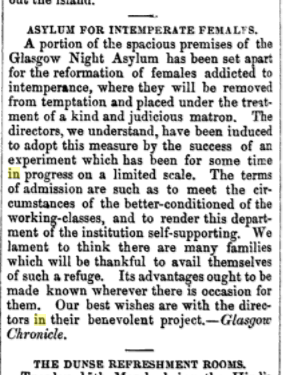
Stumbling through the internet the other day searching for something or other, I came across this small story from the June 1853 issue of The Abstainer’s Journal, a publication run by Rev. William Reid in Edinburgh, a noted member of the Scottish temperance movement back then.
What immediately caught my attention (as I’m sure it did you, too) was the “Asylum for Intemperate Females.” And I was deeply struck, as well as confused, by the euphemism contained in the “reformation of females addicted to intemperance.”
Now, I’ve known plenty of men addicted to intemperate females, but females addicted to intemperance?
At first, I thought that genteel phrase must refer to women who might otherwise be known as “unfortunate women” at its more tasteful, or “bunters” at its worst. But the more I read, the more I came to understand just how innocent I was of not just the language of the time, but the morality as well.
These women were not prostitutes, but something, I now know, just as evil and depraved. They were women who drank alcohol — either those on a nonstop bender, or just women, God bless them, who had a few too many Cosmopolitans at the local Ruby Tuesday. I’m not sure. But either way, times have certainly changed. Thank goodness.
As if that wasn’t enough fun for one day, what kept me reading was the history lesson inside the several hundred pages that were brought to me by Google Books. It’s not just the self-righteous belief that alcohol is bad, it’s the tone and lessons and poems and examples and the pages and pages of “proof” (no pun intended) that the Journal provides. A drunk “platelayer” in Liverpool was hit by a train and “had his head severed from his body.” A drunk woman got hit by a cab and her arm was broken. Five ministers were admonished for various offenses: being drunk in church, drunk on the streets, drunk while “attempting to perform the marriage ceremony,” or for “habitual drunkenness” over an entire five-year span. And, by the way, “a man named Neil” in Edinburgh died after being given a drink of laudanum and alcohol by his wife, who had been drinking. (I’m not quite sure, but it seems that alcohol might not have been the real culprit there.)
So, let these be a lesson to you, whether you enjoy “intoxicating liquors,” “stimulating drinks,” “spirituous or fermented” liquids, or otherwise imbibe substances unacceptable in any of the Teetotal Societies referenced in the journal.
Yes, this Abstainer’s Journal is a page-turner. It goes on and on: “Are the French really a temperate people?” is the headline to one article. (Except for the fact that “the French are a very restless people” moving from café to café, I didn’t really learn the answer, except that it appears to be no, but they drink differently.) “Strong Drink and Crime,” is another you might read. Or, “A Drunkard’s End. A Narrative of Facts.”
And of course, there’s politics, where it seems little has changed — at least if you live in Chicago. Yes, quite interesting.
But then, like most things in history, if you think about them too long, their real lesson starts to show. And I realized how truly illuminating this was — about our journalists today.
Indeed, through no fault of my own, I suddenly saw how this quaint and scary compendium is exactly the required reading that our political journalists need.
For any of you paying attention, you might remember the hair-pulling mea culpas that our red-faced reporters were forced to pen during and right after the presidential election last year. “I think that the New York-based and Washington-based too probably, media powerhouses don’t quite get religion,” conceded Dean Baquet, the executive editor of The New York Times, in December.
“A gaping demographic gulf separates the press from the people — a gulf that undoubtedly affects the kinds of stories chosen and the way in which they are covered,” explained Neal Gabler.
Yes, it doesn’t take Pew and Gallup for you to know that reporters from the bicoastal regions of our great country need to take more trips into the center of America. And it really shouldn’t take “experts” to tell you how the mass media en masse failed miserably to cover the last presidential election. Or how the media “elite” continues to fail in their understanding of this nation’s red states. Or why some short-sighted people continue to blame that pesky thing called the electoral college for all their woes. Or how the self-aggrandizing, self-selecting, self-isolating, self-smugging intellectuals (of which I like to consider myself a member) in this country so woefully fail to understand how ANYONE could have voted for Trump and be against abortion rights, gun control, and the legalization of marijuana.
Our country, indivisible, by county. [Source here]
Or even how, while the population distribution is increasingly on their side, the expanse of land that is invisible to them has a weight of its own, whether populated by cattle, soybeans, cactus, or Republicans.
Our country, red and blue, then adjusted for population. [Source here]
So, to these people (as we pour another drink), I want to ask if they know that 18 million Americans live in still-dry counties, according to a professor at SUNY Potsdam. That almost half the counties in Mississippi and Kentucky are dry. More than half of Texas is partially dry. One-third of Arkansas. A quarter of Tennessee. Even in New Jersey, dozens of places only sell liquor by the drink. And Kansas, in fact, has still not ratified the 21st Amendment. Do any of these reporters understand why the “blue laws” are on Sunday rather than on Thursday instead?
In other words, what I believe these “journalistes” fail to recognize — or accept — is that the good Reverend Reid still lives. That many of the folks who were part of his movement brought their bags and stayed. They homesteaded in Kansas. They brought hats to Texas. They sweated in Mississippi. But mostly, they imported with them that Protestant spirit of temperance and leave-me-be that made this country as gosh-darned, wonderfully questionable as it is. (Read Joseph Bottum’s An Anxious Age for a terrific glimpse into why this still matters.)
Yes, half of my ancestors immigrated here barely speaking English with no clue of the teaching of folks like Reverend Reid. But, like many Americans, the other half of my family moved here following his brand of sober preaching. And while I can’t remember all their names, these great-great-grandmothers of mine still linger in us today.
You needn’t look hard to find them. They live everywhere in this country — though maybe not next door to your apartment. So, I recommend you go find them. And talk to them. Sit down and drink with them whatever it is they call coffee, and understand the simplicity with which they apply their ancestors’ teachings.
No, buying new boots and spending a day in Protection, Kansas, is not what I mean (however much fun that would be.) Nor do I mean touring the grain elevators and interviewing the regulars at Burger King for breakfast.
It is essential to wisdom to understand others. So, my recommendation is that every political reporter be required to leave DC and move to where the cell phone coverage sucks. Go to Walmart for your clothes and to Sunday sermons for your nap. Go anywhere you want, but get out of your digital newsrooms and spend a month or two in God-fearing country watching genetically modified corn grow.
If all of us are immigrants (which we are), then get to know the cultures that made us. To feel the plight and know the backstory of new immigrants, you might fly to Bangladesh, Guatemala, Mexico, or the Philippines. Or you might spend some days searching the internet to know the conditions in Syria, El Salvador, Libya, and Myanmar. That is essential, because understanding the backgrounds of these people who deserve to be allowed to live here is important.
But then pack up your bags and get in your car and go take a listen inside that great verdant wasteland (sorry, I mean heartland) that lies vast between our shores.
Because, while Reverend Reid and 150 years seem several galaxies away now, the five or so generations that separate our cultures continue to live, if not prosper.
Yes, the world has changed. How quaint and old-fashioned was the time when words shrill with moral righteousness and dogmatic judgment found its target in that mild, social drink of alcohol. How blessed and enlightened are we that our welcome liberal culture does not inflict restrictive religious thinking on the actions of our free neighbors.
So, as you reporters and deep thinkers enjoy your city lights, and while you ready another editorial about the scourge of tobacco and the evil of cigarettes and how they must be banished for the good of society with asylums (oops, I mean treatment centers) and with words shrill with your moral righteousness and dogmatic judgment, order another vodka, and thank your God that times have changed.
Then read a few pages from The Abstainer’s Journal, and learn a little history about why today’s political environment in this country can so often make you see red.
Lacking an honest mission, Facebook is heading down a perilous path. Like other tech giants, its rapid success and its hubris have led to a stunning lack of self-awareness.
Much is written about mission statements. We read them. We study them. We teach them. But rarely do we witness such a public lesson in mission-failure than what we saw recently at Facebook.
You can be forgiven if you missed the announcement a while back, coming as it did at the same time as the very public demise of Uber’s Travis Kalanick, who was pushed out just the day before Facebook CEO Mark Zuckerberg’s statement. (Even a report on CNBC failed a couple weeks later to notice it.
But that’s a shame. Because Zuckerberg’s announcement was a fundamentally more intriguing and telling announcement from Silicon Valley than the awful shenanigans of Kalanick.
The fact is that too many of these new companies that spring up and prosper out here don’t appear to know what they are or why they exist. And though flawed and shortsighted (we’ll get to that in a moment), Facebook’s continued attempt at figuring out where it is going by denying what it has become continues to provide a most edifying lesson for the vaunted entrepreneurial class.
Silicon Valley is filled with companies superimposing a business model on top of a new technology and defining its creation via an idealistic mission. But the common “democratize” or “disrupt” confection is not a goal in itself. It is a means to an end — an idealized (as well as monetized) end — usually left for later.
Like Uber (though it’s at a different stage of maturity), Facebook has apparently overrun its headlights. Its early mission achieved, it finds itself in a place it apparently never saw coming.
“Unless a leader knows where he is going, any road will take him there,” Harvard Professor Theodore Levitt famously cautioned nearly 60 years ago.
And therein lies the danger, which for Facebook and many others, is twofold and real: not only does the lack of an honest mission leave your future direction unclear, it also opens the door for others to define you no matter what you might argue. In either case, it’s not a path you want to travel.
POWER TO THE PEOPLE
“Our mission is to make the world more open and connected.” This was Facebook’s well-known mission since at least 2012 when it had 900 million average monthly users and first sold stock to the public.
Now, with 2 billion folks a month perusing the site, and with government officials in various countries breathing down its neck, the company is being forced to grow up in a way that is not too dissimilar than any nouveau riche when they bemoan the fact that, now that they’re rich, why aren’t they happy?
“We’re getting to a size where it’s worth really taking a careful look at what are all the things that we can do to make social media the most positive force for good possible,” Facebook Chief Product Officer Chris Cox told TechCrunch in late June.
I’m not sure how 900 million users were not sufficient to start considering being a force for good, but better late than never. You would think a company with a market capitalization of well over $400 billion would be thinking ahead a bit more. Given its new mission statement, however, apparently not.
That was then followed by Zuckerberg’s extensive ruminations on the company, the world, and all that’s in-between, in his letter to the planet in February of this year. “Our next focus,” he wrote, “will be developing the social infrastructure for community — for supporting us, for keeping us safe, for informing us, for civic engagement, and for inclusion of all.”
So here we have it — the company’s new mission:
“To give people the power to build community and bring the world closer together.”
FIRST, DO GOODER FOR THE WORLD
Facebook began with the simplest of intentions. The company was founded upon an idea that people are interested in what their friends are doing. That approach depended on a basic self-selection of individuals that was left open to Facebook users. Create a personal page, let people knock on your door, and decide whom you let in. What could be wrong with that? What could be more powerful in giving “people the power to build community?”
But the company quickly became more. Although Facebook remains fundamentally a platform for people to communicate with one another, its dominance and its marketplace expansions have placed it in a different sphere. And (just like in real life) its success has propelled it headlong into a reality at odds with its ideality.
The original mission of Facebook firmly set the stage for this unavoidable conflict. That is, that an “open and connected” world was necessarily a good thing. Probably it is. But it is no more an axiomatic positive than is a mission that implies a “closed and restricted” world is good. Arguments, based on presuppositions about society and human relations, could be made on either side.
Indeed, that is precisely what Facebook discovered. A platform that allows the world to be completely “open and connected” — with no exceptions — is not necessarily an unmitigated good. So, exceptions and restrictions were needed.
Any person or company must be on guard against propagating evil dealings, hate speech, or incitement to violence, especially outside the US. And it goes without saying (or at least it should) that any endeavor must needs follow the Hippocratic approach: “First, do no harm.” (Or “Don’t be evil” if you’re Google, though even that has changed to “Do the right thing” in its code of conduct.)
But “developing the social infrastructure for community — for supporting us, for keeping us safe, for informing us, for civic engagement, and for inclusion of all?” There is a fundamental difference between weeding your garden and pursuing a scheme to plant and nurture.
Ask any daily newspaperman about the difference between providing a platform to print information and one that seeks to influence. The Muncie, Indiana, newspaper once had a quote from Abraham Lincoln as its motto: “Let the people know the facts and the country will be saved.” It did not say “Let the people know some of the facts based on our algorithms and we can help the country be good.” That is dangerous territory to enter to be sure.
TECHNICALLY, NOT A MEDIA COMPANY
The question is, if fully considered: Does the new statement from Facebook truly reflect the company’s mission?
It’s nice they want to help us build community. But does anyone think they don’t intend to “help us” along? With more algorithms. More manipulation. Or, by definition, more control of our conversations for purposes of social engineering.
Is this the mission that Facebook truly pursues?
“We are a tech company, not a media company,” Zuckerberg has doggedly maintained. And for good reason. It is vital for Facebook to remain under the protection of the Communications Decency Act of 1996, which frees it from many potential penalties faced by media companies.
“No provider or user of an interactive computer service shall be treated as the publisher or speaker of any information provided by another information content provider,” the law says.
But Facebook’s new mission not only complicates things, it is likely to lead others to redefine it regardless what it might argue. Ever since its controversial launch of its News Feed in 2006, it has been proceeding down an increasingly dangerous path. And the company’s recent introduction of its Watch video service is further evidence of its true business model — a model that flies in the face of its stated mission, no matter what it claims to the contrary.
In essence, the company, which once appealed directly to its users as customers, is no longer transacting with them. The transaction now is between Facebook and advertisers. This was to be expected, of course, as the company seeks to monetize its position. But by increasingly managing and controlling the relationship between provider and customer, as well as paying people to create content, it is following a path similar to the one that continues to plague Uber as that ride-sharing company increasingly and vainly argues it is merely an app interface introducing independent drivers to riders.
Yes, Facebook has been singed by political fire for spreading false news and hateful speech. But it’s a fool’s battle to attempt to stymie people’s addle-brained gossip and crack-potted conspiracy theories. Back-fence talk has been happening ever since fences were created. Conspiracy theories and hate go back even further. Hiring 3,000 humans — or even 30,000 — to hit a delete key with the aid of some algorithms meant to ferret out objectionable talk will help — but it will eventually fail.
These days, information is shared, not transacted. Readers are no longer customers; they are consumers. In social media, given Facebook’s dominance, the consumer is no longer asked to select the source of information it is willing to pay for. They go to a location. They visit a site. And without transacting a thing, they receive information.
In essence, despite some alternatives, Facebook has created nothing less than the equivalent of a one-newspaper nation as two-thirds of US adults use Facebook and two-thirds of them are reading its news. Indeed, the majority of those say it’s the only news they read. Imagine the only newspaper in town printing nothing but Letters to the Editor and stories (selected solely based on readers’ interests) that come only from news wires. It prints what it does, it claims, to promote a sense of cohesion within the community. Can you imagine anyone not regarding that as a media company?
The law that protects Facebook and other internet services was written two decades ago to help “promote the continued development of the Internet” and “to encourage the development of technologies which maximize user control over what information is received.”
Yet, few would argue that government support dating to 1996 is needed today. In fact, now it’s the newspaper publishers who are going to Capitol Hill for help. Nor could one argue that Facebook’s new mission will “maximize user control over what information is received” Indeed, quite the contrary.
TRY NOT TO BE SHITTY
Yes, it is admirable that Facebook wants to improve the world and make us all more neighborly. It’s important to inject a bit of corporate heart and soul and idealism into any mission — if it’s believable. But to adopt a mission to bring the world peace or to alleviate the world’s hunger is neither actionable nor helpful on its face.
And as Peter Drucker cautions, an effective mission statement “is a call to action rather than pious intention. It tells the people in the company what their values are, and what effectiveness means for the company and for their own work.” For that, a realistic perspicacity must exist. It is not enough to have idealism.
Consider the mission of WeWork: “to create a world where people work to make a life, not just a living.” Or Pinterest: “to help people discover the things they love, and inspire them to go do those things in their daily lives.” Or Lyft:”to connect people through transportation and bring communities together.” Even “We’re trying not to be shitty,” the “sort of” mission statement for Vice’s cable channel as described by its founder Shane Smith.
Each of these is pointed, self-evident in value, and — most important — is something the company can pursue without running counter to what the company is. (And at least Lyft’s mission to “bring communities together,” sounding inordinately similar to the new Facebook statement, can be understood literally.)
A MISSION TO CHOOSE A MISSION
But while laudable on the surface, Facebook’s new mission does little to provide much beneficial direction. It discloses not only a suspected arrogance about its abilities, but even an implicit cynicism about people’s ability to create a good world without technological assistance.
It also can’t help, at times, to appear at odds with itself.
“We are an open platform for all ideas,” a company executive wrote on Facebook’s blog in June, just before explaining how and why the company deletes nearly 10,000 posts a day.
“People need safe spaces to share things that are private to them,” Facebook’s product manager for groups, Alex Deve, told a writer for The New York Timesrecently. That doesn’t sound much like an endorsement for total openness and connectedness, or even bringing the world closer together.
Perhaps, it should look back and rediscover its reason for being in the first place. After all, as one employee told NPR, “We started out of a college dorm. I mean, c’mon, we’re Facebook. We never wanted to deal with this s**t.”
So, what does it do? The company might trust its customers once again and rather than algorithm what (and whom) they see, it should return to that fundamental trust. Let its users self-select on their own. If we have too many friends posting too many videos of their cats, let us decide to defriend or unfollow them. If we have a friend who posts once a year, let us see the post at the top of our page and allow it to remain there.
Left to their own devices (literally), people would naturally “algorithm” themselves — with equal, if not more efficacious, results. After all, algorithms are simply decision-making instructions, and as Daniel Kahneman notes in his book Thinking, Fast and Slow, in a study of multiple regression, sophisticated algorithms are not nearly as clever as their developers often believe.
I am not opposed to algorithms, nor to Facebook using them. But the company must recognize that the more it infiltrates our choices, the more decisions it makes on our behalf, the more nebulous its mission threatens to become. Indeed, it is to enter and roam in a minefield that has no exit.
The only way to safeguard itself, then, is that it must come to grips with what it is, or rather, what it wills itself to be. If it has forsaken its definition as a mere platform, it must do a better job at discerning its true nature and with it, its mission.
One thing is certain: Facebook is not a simple “interactive computer service” with a goal to “maximize user control over what information is received.”
So, perhaps, it’s an entertainment company. After all, it’s beginning to fund video projects and video publishers to create TV shows for the site. No one would argue the owners of cinemas (the old-fashioned site we used to visit to view content) were media companies. They were in the entertainment business. Maybe that is Facebook also — an entertainment company.
Or, perhaps, Facebook should accept a mission as the world’s dominant distribution channel, in which case, it might focus its algorithms — and its business — solely on selecting customer segments for its revenue-generating advertisers.
Maybe it should stick with being a dull technology company — a passive platform on which participants are left to create “unalgorithmed” content, allowing us to see whatever is posted (that’s not legally prohibited) and let us use the algorithms that God placed in our brains.
Or, if it is willing to be totally open and connected (to reality), then it might even concede that its true mission is simple: It is to make money for its shareholders by enticing people to display and view things — thoughts, pictures, videos, information, etc. — from anyplace in the world (except China, of course). That is something, to its credit, the company is doing quite well. And that, more than anything, I would argue, is the path it is pursuing.
Regardless, it seems clear that Zuckerberg would at least be better off accepting that his idealism is best concentrated in his Chan Zuckerberg Initiative, where it belongs, than in his publicly traded company. Besides, the CZI mission, “Advancing human potential and promoting equal opportunity,” is at least clearer and more appropriate to that organization’s nature.
But of course, a stated mission merely to entertain, to sell, to passively host — or to make money for shareholders — lacks a social commitment of beneficence that today’s ethos demands. Instead of “do no harm,” the often-false idealism that is glossed over much of Silicon Valley (this generation’s new intersection of Haight and Ashbury streets) requires a “do good” approach.
There’s nothing inherently wrong with that. It takes idealism, arrogance, and energy to create a business. But Facebook needs to admit its reality. It is not a platform for good. It is a business. And as a business, it might also do good. But its mission is more (or perhaps less, depending on your view). It is to entertain. To divert. To provide a platform for connections. To try to do no harm. And also, yes, to make money for its shareholders.
IS THE ATTACHÉ CASE READY?
So, what precisely should Facebook’s stated mission be?
Not being invited into its closed-door meetings, I don’t know. The company’s success has placed it in an almost impossible position. But I do know the company needs one. And it needs a better one. And for that, it needs to do a much better job thinking through and declaring a mission that goes beyond stating something that feels good while attempting to sidestep the minefields of media definition. It needs a mission that is real.
Without it, the company will lack a complete and sincere understanding of what it is and even where it is going.
My guess is that Zuckerberg is much smarter than this. It’s likely he finds himself confined either by his own success or an idealism running headlong into reality. But he needs to do better. If not, to borrow Levitt’s conclusion, he “might as well pack his attaché case and go fishing.”
I don’t think he’ll do that, nor do I think he should. But if the company continues in this direction, he might want to start considering a new motto for Facebook’s homepage. “All the Posts that are Fit to Post” has a nice ring to it.
You can learn a lot about a society by the way people drive. The problem is I’m just not sure what that is.
I always found driving in New York City relatively easy. You raced up or down the avenues timing your ride to the timing of green lights. You did everything you could to avoid going crosstown. You cut in front of anyone. You swerved around potholes in the middle of heavy traffic after a pretend glance in the mirror. You battled other cars, avoided fighting taxis, and you knew pedestrians would run. And
as your car sped forward and you flew down the streets, you knew all was ok because everyone was doing it, like the instinctive fluid motion of a school of big fish.
Yield straight and left.
Driving in Mexico City was not quite the same. There, mostly you crept onto the city’s main streets and basically parked, sliding forward at about the same pace as the sun overhead. And while you kept an eye out for thieves, vendors in the road would walk past your car selling ice cream and water and garment bags and pencils. If you ever got as far as an intersection,
you knew whichever car’s bumper was the first one to arrive had just won the right to move the next inch. There was competition to be sure, but never did I find it aggressive or mean.
In Dallas and New Jersey and Baltimore, driving was simple. Most of the roads were straight. There were always some madmen around but everyone was so afraid of dying that people generally took care. In Los Angeles, it was like driving in a video game only a lot less believable. And in Washington, D.C., with all the avenues on diagonals, traffic circles and one-way streets, half
the drivers were lost, so you were always in good shape if you had any idea where to go.
In England, simply put, driving was boring. Except for the fact that everything was on the wrong side of everything, traffic moved politely as if everyone was waiting in a 60-mile-per-hour queue.
Yield everywhere.
Even driving a taxi 12 hours a night in Philadelphia was ok. It wasn’t the traffic and other drivers you worried about anyway. It was the ranting, gun-wielding passengers – who were almost as scary as the Yellow Cab’s Teamster bosses.
No, it wasn’t until I got to Bucharest that I truly learned to fear driving. It’s not the roads or the traffic that make traversing the city so scary. It’s the other drivers and pedestrians and the fact that all the lights are put in the wrong place. (In case you’ve not been here, the signals are sadistically located
Yield some more.
before you go through the intersection so when you find yourself halfway across an expanse of pavement about the size of Bermuda and you begin to see other cars moving at you, you have no way of knowing if you should stop where you are or play bumper cars up ahead. Even when you do stop in time, if you have the unfortunate luck to be the first at the light, they are now so far to the side or somewhere above you, you need to wait for the very helpful and friendly honking of the 20 cars behind you gently intimating in unison that the light has turned green.)
But then slowly you learn that to survive driving here, you must master only two things. Yes, only two things. Firstly, you have to assume that everyone is driving rationally and carefully just like you and then you must dismiss that thought entirely and instead anticipate them doing precisely the opposite of whatever you would expect.
With no right on red allowed here, you apparently have to wait to yield until you have the green light.
After you do that, then you’ll discover that whatever you’re now thinking is also not at all what they’ll do and instead you should anticipate that what’s most likely to happen is whatever is inconceivable for you to imagine them doing. And finally, you learn that’s not what they’ll do either. Once you know this, you’ll begin to be fine.
Fine, that is, until you run into the second small problem: pedestrians. (And please know, of course, that when I say “run into” pedestrians, I mean that literally). You see, because the streets are too long and there are not enough lights, the city is strewn with a few million random crosswalks painted anywhere someone wants one, across little streets, across big thoroughfares, a few that cross highways and one or two on airport tarmacs. It really doesn’t matter. What’s vital to know is that it’s your job as a driver to stop (now that sounds Communist to me, no?) and the way you know to do that is you must watch for one of the few million small signs, made of a blue invisible substance, that are somewhere not near the road. So as you’re driving and praying that the car to your left doesn’t suddenly swing right for absolutely no reason just as the guy backing out of his driveway into the road without looking will stop in time for the car driving along the sidewalk to pull into your lane you also are expected to be searching for some sign that you can’t see to warn
you that in seconds an old lady is about to step in front of your car.
Got it? Ok. Now that you understand this, let me tell you the really strange thing about driving here. There are no Stop signs.
That’s right. And when I say there are none, of course, I mean I’ve seen three. In the entire city of 2 million people, each of whom appear to drive eight or nine cars. Yes, three – and two of them were in the same place.
Don’t ask me why. For some unknown reason having to do with the homogenous Dacian-Latin-Saxon-Slavian-Magyan culture or perhaps an endemic genetic Bucharestian fear of octagons, the idea of Stop signs apparently never arrived here. Personally, my theory is that everyone expected the Americans to bring them when they got here at the end of World War II – and we know how that worked out.
I have no idea what these yellow boxes mean, but if I were you, I would yield here, too.
Now, for those of you who have never driven between here and the US, let me tell you that in America there are Stop signs everywhere. Even in parking lots and alleys and at the end of one-way streets. If there’s room, there’s a Stop sign. It’s part of our national philosophy: “If in doubt, make them stop.” (And if you’ve seen recent stories about our police, you know what I mean.) And if we don’t make you Stop, then we tell you to Go. No weak, in-between indecision for us. No sir. Because as Americans, you should know, it’s always more important to make a definite decision than to worry about being right.
And the fact is, in most of this country, there are plenty of Stop signs. Yet here? Instead, in Bucharest, everywhere, you are ordered to Yield. Not Stop. Not Go. Just Yield. In other words, don’t stop unless you have to – and if you do have to, then go ahead and pull out into the intersection and make the other guy yield to you.
One of the three Stop signs in Bucharest.
In a way, it makes sense. Of course, when coming to an intersection where there are busses and bicycles and cars and motorcycles and trucks and scooters and baby carriages and skateboards and shopping bag-laden old women chasing trams that are speeding left and right with another couple roads that all come together, you’re likely to consider the idea of stopping just a little if for no other reason than to miss out on a sudden and painful fire-consuming death. I also suppose Yield signs everywhere help avoid the complication that other cities suffer when they must explain that, though it says Stop, the sign also tacitly contains the concept “and then Go. ”
In some ways, of course, “Yield” is less harsh of a concept than the order to “Stop.” But given the decades of Communism when “Yield” was how you lived unless you wanted to go to jail, wouldn’t you rather read a sign that is more democratic and generally more honest? Yes, a sign that more accurately reflects the values of society. A sign that honestly conveys how people think and drive. I wonder what shape we should use for a sign that announces: “Warning: If you don’t hurry up, the other guy wins.”


 Because Credit Karma didn’t just overlook a small rule, the company “failed to comply with the disclosure requirements,” the SEC said, “even though senior executives were aware” of the rule, which required the company “to provide financial statements and risk disclosures a reasonable time prior to the date of exercise of any stock options.”