by Peter H Frank | Aug 21, 2013 | Literature |
Rather than remain silent while I finish a few projects and prepare for some travel, I thought I would be kind and share with you a wonderful, thoughtful passage from one of Michel de Montaigne’s essays, On Books.
A New York Times story a year or two ago, referred to him as perhaps the world’s first blogger, though in the late 1500s (at least in France where he lived), there was no internet so these were not posted until more recently.
Speaking of time, this will take you a little time to read. So sit back and read this the way you should read all his essays (and you should read all his essays): just let him talk to you. (Wouldn’t it be great if all bloggers had this much self-awareness and saw this much value in thoughtful reflection?)
* * *
“I make no doubt but that I often happen to speak of things that are much better and more truly handled by those who are masters of the trade. You have here purely an essay of my natural parts, and not of those acquired: and whoever shall catch me tripping in ignorance, will not in any sort get the better of me; for I should be very unwilling to become responsible to another for my writings, who am not so to myself, nor satisfied with them. Whoever goes in quest of knowledge, let him fish for it where it is to be found; there is nothing I so little profess. These are fancies of my own, by which I do not pretend to discover things but to lay open myself; they may, peradventure, one day be known to me, or have formerly been, according as fortune has been able to bring me in place where they have been explained; but I have utterly forgotten it; and if I am a man of some reading, I am a man of no retention.
“So that I can promise no certainty, more than to make known to what point the knowledge I now have has risen. Therefore, let none lay stress upon the matter I write, but upon my method in writing it. Let them observe, in what I borrow, if I have known how to choose what is proper to raise or help the invention, which is always my own. For I make others say for me, not before but after me, what, either for want of language or want of sense, I cannot myself so well express. I do not number my borrowings, I weigh them; and had I designed to raise their value by number, I had made them twice as many; they are all, or within a very few, so famed and ancient authors, that they seem, methinks, themselves sufficiently to tell who they are, without giving me the trouble. In reasons, comparisons, and arguments, if I transplant any into my own soil, and confound them amongst my own, I purposely conceal the author, to awe the temerity of those precipitate censors who fall upon all sorts of writings, particularly the late ones, of men yet living; and in the vulgar tongue which puts every one into a capacity of criticising and which seem to convict the conception and design as vulgar also. I will have them give Plutarch a fillip on my nose, and rail against Seneca when they think they rail at me. I must shelter my own weakness under these great reputations. I shall love any one that can unplume me, that is, by clearness of understanding and judgment, and by the sole distinction of the force and beauty of the discourse. For I who, for want of memory, am at every turn at a loss to, pick them out of their national livery, am yet wise enough to know, by the measure of my own abilities, that my soil is incapable of producing any of those rich flowers that I there find growing; and that all the fruits of my own growth are not worth any one of them.
“For this, indeed, I hold myself responsible; if I get in my own way; if there be any vanity and defect in my writings which I do not of myself perceive nor can discern, when pointed out to me by another; for many faults escape our eye, but the infirmity of judgment consists in not being able to discern them, when by another laid open to us. Knowledge and truth may be in us without judgment, and judgment also without them; but the confession of ignorance is one of the finest and surest testimonies of judgment that I know.
“I have no other officer to put my writings in rank and file, but only fortune. As things come into my head, I heap them one upon another; sometimes they advance in whole bodies, sometimes in single file. I would that every one should see my natural and ordinary pace, irregular as it is; I suffer myself to jog on at my own rate. Neither are these subjects which a man is not permitted to be ignorant in, or casually and at a venture, to discourse of. I could wish to have a more perfect knowledge of things, but I will not buy it so dear as it costs. My design is to pass over easily, and not laboriously, the remainder of my life; there is nothing that I will cudgel my brains about; no, not even knowledge, of what value soever.
“I seek, in the reading of books, only to please myself by an honest diversion; or, if I study, ’tis for no other science than what treats of the knowledge of myself, and instructs me how to die and how to live well. ...”

by Peter H Frank | Aug 8, 2013 | Cooking |
Berry Cobbler with Crumble Topping
So, as you don’t know, my daughter Hannah and I are writing a cookbook for Romania. It will be done soon. This recipe is not in it – but in the final cooking stages, I decided to look for – and adapt – a very, very simple recipe for all these beautiful berries we are finding at the market: blueberries, raspberries, blackberries.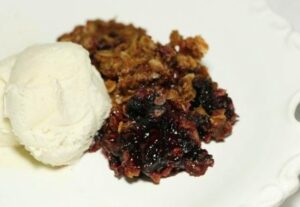
There is no excuse for not making this, no matter who you are. It’s as easy as making a bowl of cereal and a cup of coffee.
Just a few pointers:
1) This is gluten-free, but if you don’t have a reason to avoid gluten and if you don’t have rice flour at home (and you probably don’t) you’ll see here you can just use regular flour flour.
2) Please use (or plan to buy either online or at a health food store someday soon) real vanilla extract. This recipe calls for vanilla, and the vanilla essence you sell here is awful. You can leave it out.
3) This is rather sweet (it’s supposed to be), but feel free to cut back a little on the sugar if you prefer.
4) Add a pinch or two of ground cinnamon. It’s a great addition if you like the flavor.
Or don’t bother with any of that and just throw this together, then serve with some good vanilla ice cream:
Preheat oven to 175 degrees C.
Combine in a bowl with a whisk or big spoon:
- 3 cups (500 grams) berries – blueberries, raspberries, blackberries – any combination
- 2/3 cup (160 grams) white sugar
- ¼ cup (30 grams) lightly packed corn starch
- 1 tablespoon lemon juice
- 1 teaspoon vanilla extract
- (Couple pinches of cinnamon if you want)
Pour into a 9-inch pie plate, large glass casserole dish, or a bunch of small ramekins (don’t fill to the top).
Combine very, very well in a bowl with your fingers:
- 1 cup (120 grams) oatmeal
- 1 cup (220 grams) dark brown sugar (Sano Vita dark brown sugar is good)
- 5 ½ tablespoons (80 grams) butter
- 4 ½ tablespoons (40 grams) rice flour [or use 5 ½ tablespoons (50 grams) wheat flour]
Carefully place crumble mixture on top of berries, careful to distribute evenly so one part doesn’t sink in before you get it all covered and into the oven.
Bake at 175 degrees C for about 35-45 minutes.
BE SURE TO PUT SOME ALUMINUM FOIL ON AN OVEN RACK UNDER IT!!!! IT WILL DRIP!!!!

by Peter H Frank | Aug 6, 2013 | Culture, How I Know I'm Not in New York, Life in Romania |
“To Fan or Not To Fan”
My Romanian friend Remus came to my office the other day.
“Hi, Remus. Have a seat.”
“Thanks.”
“How are you?”
“I’ve been better.”
“What’s the matter?”
“Hey, do you mind?”
“What are you doing?”
“Turning off the fan.” (more…)
by Peter H Frank | Aug 1, 2013 | Journalism, Media, Politics |
Allow me to revisit my short comment from the other day about Romania Libera’s interview with President Basescu. It seems that based on some questions and comments I received, it might be best if I clarify what I meant.
Yes, any interview with the president is important. What the president says is important. It is perhaps appropriate to run a transcript of his comments as if he was being deposed. But if you conduct an interview with the president and you cannot derive a headline of news from his comments, then I fear the conclusion must be that you’ve asked the wrong questions.
There must be something he is planning that will make news. Your job is to uncover what it is before it happens. You cannot do that, however, if all your questions (as they were) were essentially asking what he believes, or what he thinks about various issues.
I know no one who cares what President Basescu thinks. That is not meant as an insult. It’s not because what he thinks is not relevant, and sometimes even interesting, but because it is not what he thinks, but what he plans to do that is at issue.
He is an elected politician who has the power, given to him by the public, to do things. He is not a scholar, an author, a philosopher, a theologian, a professional thinker of any kind who fascinates us and whose very thoughts and perspectives will change the way we see the world.
He is not even Lady Gaga or Brad Pitt, who have no particular power except the influence of personality and celebrity. I might care – sometimes – what Jay-Z thinks about lowering the tax on bread. President Basescu, however, I do not. He is a public servant who is paid to do things, so I care not what he thinks, but what he plans to do about those taxes.
If you say perhaps I misunderstand, the president here doesn’t really have the power to do anything, then I suggest you ask him what he intends to try to do and how. If he doesn’t even have the power to attempt anything, then I would question whether the interview was even worth conducting.
Look at it this way: If President Basescu says he believes everybody should be happy, and thinks Romania and Moldova should have one big beer bash, and we should stop all the arms dealers, and let women run the country, and the whole world should sit around the campfire and sing Kumbaya – that’s just lovely, but I don’t really care. Wake me when he says how he intends to do it. Now that will be news.
Yes, it is very hard to write a strong lede from “President Basescu said yesterday he thinks…” as opposed to “President Basescu said yesterday he will…”
Maybe that’s why there was no story and hard lede about the content of the interview. (That was my criticism in the blog posting on Monday.) Perhaps, in fact, there was no hard news to be found in all those things the president thinks.
Now, I concede that sometimes what a politician believes, or thinks, or knows, is important. Mostly if he’s not yet elected, it can be important what he believes to indicate what he might do when he takes office. What he knew and when he knew about a subject can also be important to determine on what information he acted, or if not, then why not.
But it’s the action, not the thinking, that’s ultimately of importance. Once elected, while you can ask a politician what he believes, it’s only in the follow-up (“So what will you do?”) that the real news is made. And if they give a “no comment,” the reporter might laugh, but they never should shrug. You follow up with a question that will provoke an answer, because if the question was important enough to ask the first time, then isn’t it important enough to push for an answer?
No, I fear the saddest part is that as long as reporters here ask the politicians what they think, what they fear, what they hope, what they believe, why they’re great, and why the other guy is not – and not what they will do – the media here is failing in its role. They are more part of the game than its watchdog or critic, enabling the same tired name-calling and rhetoric and sophistry that is so destructively – and unproductively – practiced by this country’s politicians.
Finally, a suggestion: At one of the newspapers I worked for, we had a News Editor, or front-page editor, who was third in command after the Executive Editor and the Managing Editor. Everyday, just before lunch, in the middle of the newsroom, he would publicly review that day’s front page, complimenting this story or criticizing that headline. It was a delicate process, and at times very painful, but over time reporters and editors began to see what was expected and how to improve.
This perhaps, I suggest, would be useful to reporters and editors here, to review what they did and to see the missed opportunities and to congratulate those who did a good job. Because good stories do happen here, just not often enough. And if journalists aren’t tough enough to take some brutal criticism, the kind they like to write about others, then they’re merely writers, not journalists, and they’re in the wrong business.
by Peter H Frank | Jul 12, 2013 | Business, Journalism, Media |
A Simple Conclusion
Feel free to dismiss all of this. After all, I’m from the US. What do I know? Things are different here. That’s what some people tell me.
Perhaps they’re right. But judging from the reaction that I’ve received in private regarding this long essay, while witnessing so little public comment or debate, I can’t help but be dismayed by the sad state of the industry here. Nodding in a smug, self-satisfied way does not absolve a person from responsibility. Knowing while not acting is not an accomplishment to be proud of. Isn’t that precisely what journalists rightly criticize others for doing? Isn’t the argument of ideas, after all, at the very heart of good newspapering? (more…)
